
Somewhere in an inbox in Brussels right now, there's an email that starts with "Dear Sir/Madam, my name is… and I am a second-year student at…" It's three paragraphs long; it has a CV attached, and near the bottom it asks whether there might be "any opportunities available". If you know anyone who sends emails like this, let me tell you: They probably aren't getting the reply they expect.
That's not because the student isn't talented. It's because the email asks a busy stranger to do all the work: read a life story, work out what you want, and then decide whether to give it to you. Most people don't say no to emails like that. They just never get round to saying yes.
Why cold emails still work
A job portal puts you in a pile with hundreds of other applications. A good email puts you in front of one person, with your name at the top. Many internships, especially at startups and smaller companies, are never properly advertised. When a team needs help, someone asks around, and a short, well-timed email is how your name comes up. You have to be the best one so that people at least remember who you are…
“The goal of a cold email isn't to get a job. It's to start a conversation.”
Once you see it that way, everything about how you write it changes.
The four sentences that do the work
An email that gets a reply is short enough to read on a phone between two meetings, without scrolling. That's about four sentences, one for each job the email has to do.
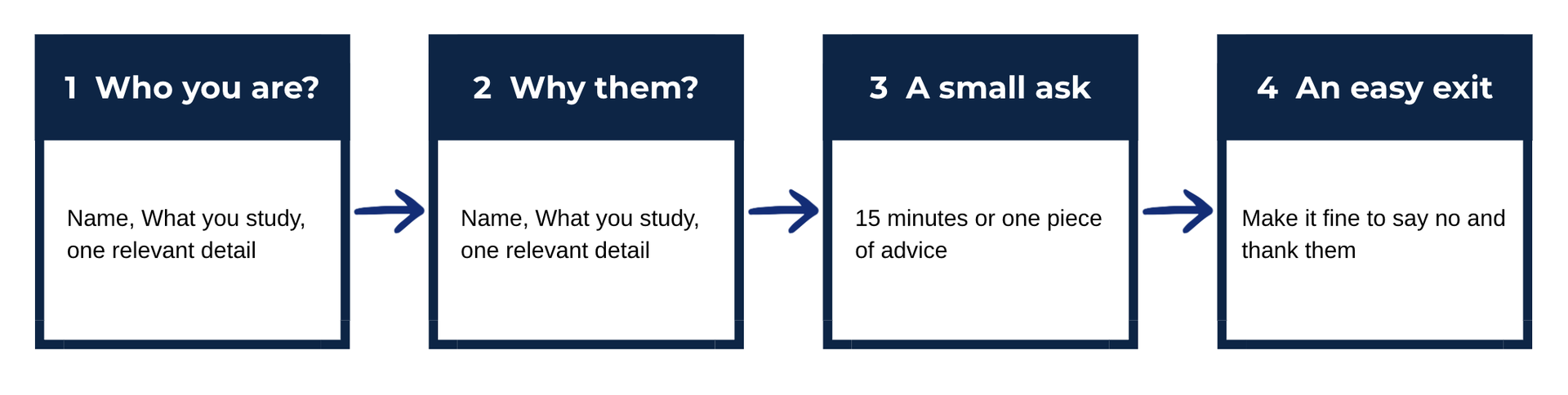
“The four-sentence cold email: one job per sentence, short enough to read on a phone.”
The first sentence says who you are. The second matters most: mention something real about the person's work, like a post they wrote, a project they launched or a talk they gave. If you can't find anything specific, you're probably emailing the wrong person. The third is a small ask they can say yes to in five seconds. The fourth makes it easy to say no. That sounds odd, but taking the pressure off makes people more likely to answer.
The subject line decides if it gets opened
|
Gets skipped |
Gets opened |
|
Internship opportunity |
KU Leuven student — question about your team |
|
Hello |
Your post on [topic] + a quick question |
|
Application for any position |
15 minutes on your path into consulting? |
When nobody replies
Many emails won't get an answer
the first time. That's normal and rarely personal. People read emails on the
train, mean to reply later, and later never comes. One polite follow-up often
gets the reply the first email didn't.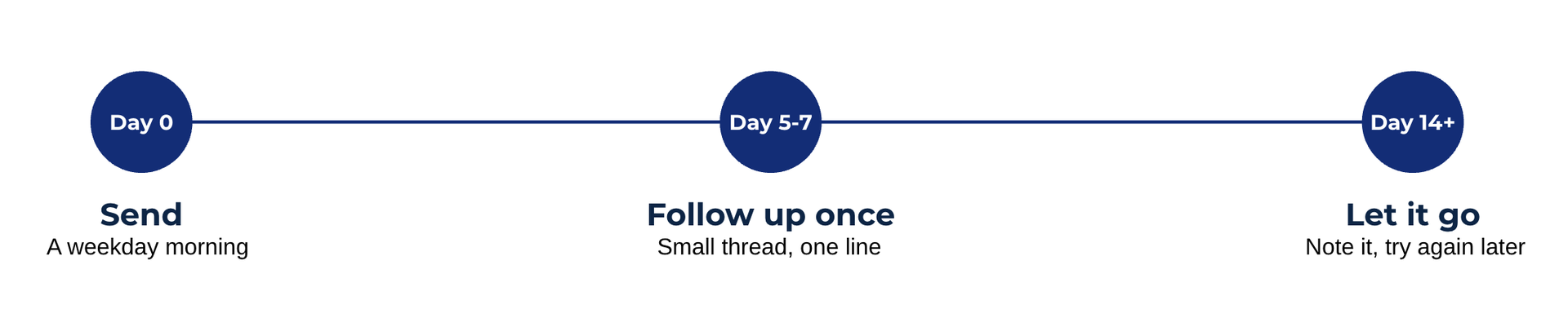
“One email, one follow-up, then let it go.”
The template
Subject: [University] student — quick question about [their team / their work]
Hi [First name],
I'm [Name], a [year] [programme] student at KU Leuven Brussels, and [one relevant detail].
I [read/saw] your [post/talk/project] on [topic], and [one honest sentence on why it stuck with you].
Would you be open to a 15-minute call in the next few weeks? I'd love to hear [one specific question].
Totally understand if you're busy. Thanks for reading either way!
Best, [Name] · [LinkedIn link]
Three things to remember
1. A cold email starts a conversation. It doesn't ask for a job.
2. Four sentences: who you are, why them, a small ask, an easy exit.
3. Follow up once after about a week, then let it go.
Your one thing this week
Pick three people whose job you'd really like to understand: an alum, someone at a company you admire, a speaker from a recent event. Send each of them an email using the template. Not thirty. Three good ones. Then set a reminder to follow up next week.
Tell me: Have you ever sent a cold email that worked? What did you write?
If you have any questions, you can always reach out to us — we're happy to guide you through it. And if you're interested in taking your communication skills beyond the inbox, join us on 20 October at 18:00 at KU Leuven Campus Brussels for our upcoming event with Cartoonbase.
Cartoonbase is a unique consulting firm where consultants and artists work together to help organisations lead change, communicate ideas, and bring people around a shared vision. In this session, we'll explore the power of storytelling: how to turn ideas into narratives that people actually understand, remember, and care about.
Because whether you're writing a cold email, presenting an idea, or trying to make people believe in something, the story you tell matters.
📍 KU Leuven Campus Brussels
📅 28 October
🕕 18:00
👉🏻 Register here: https://forms.gle/p8UmBgurcSibdYxh9